THE RETURN TO VALVES IN HIGH-END
AUDIO APPLICATIONS
By Warren Lane, Australia.
During the last few years, valves have enjoyed a return to favour with
audio enthusiasts and now professionals are seeking their characteristics
and perceived advantages within studio recording equipment.
This article attempts to analyse the differences between valve and solid-state,
both objectively and subjectively.
Five years ago, whilst browsing in a newsagency, my attention was drawn
to an English Hi-Fi magazine. What attracted me was a cover illustration
of a very ornate copper-plated chassis, bearing four large output valves
instantly recognised as type 2A3, which had made its debut in the early
1930's. Even though these valves were obsolete long before my passion for
music and quality reproduction began in the late 1950's, I was aware of
how successful and how popular these valves had become as audio output types.
Yet here they were being used in an amplifier manufactured in 1992! My curiosity
aroused, I bought the magazine with the intention of discovering why an
amplifier with such obviously modest specifications would interest today's
enthusiast.
The amplifier produced 7.5 watts of power, had zero negative feedback,
(NFB) and used paralleled output valves in single-ended configuration, once
associated with less expensive amplifiers. Push-pull operation had long
been favoured over single-ended for its lowered total harmonic distortion
(THD) content. Why then was this design selected for an amplifier competing
with sophisticated solid-state designs with superlative specifications orders
of magnitude better than it's own?
The reviewer was however, very impressed with the performance, according
it very high honours indeed. It was about this time I wondered about the
cost of such a beast; being hand-made, it surely wasn't cheap. I was right
about this at least, it carrying a retail price of 6,900 pounds sterling
or 8,900 pounds for the deluxe model with silver-wound transformers and
silver-foil capacitors! I was directed to an article in the same magazine
(more in the form of an advertisement) relating to other zero NFB amplifiers
of considerably more power, including one with push-pull 845 transmitting
triodes in class-A yielding 50W. RMS that sold for-wait for it- 90,000 pounds
sterling- no, this is not a misprint, ninety-thousand pounds! I closed
the magazine in somewhat of a shocked state, muttering something about fools
and their money!
Now I must confess, along with my solid-state Quad 405 current-dumping
amplifier, which has given satisfactory listening for many years, I do own
a pair of Quad QII valve power amplifiers which sound very nice, but I guess
the lure of all the power margin afforded by the 405 caused me to only use
the valve QII's in cases of extreme nostalgia. Yes, I like valve amplifiers,
they look very attractive, they sound different in some respects to solid-state
models, on some recordings even dare I say better, but on others the sheer
dynamics of powerful solid-state models couldn't be ignored. You must understand
that during my formative years, I developed a close bond with things thermionic
and perhaps I may be a little over-biased (no pun intended). However, when
solid-state amplifiers came of age in the latter part of the 60's, I embraced
the new technology with all the enthusiasm expected of an audio enthusiast
in a quest for louder reproduction of such classics as Credence Clearwater
Revival, Elton John, Wings and similar. As my tastes matured, I found a
liking for female vocals, but observed that the female, and to a lesser
extent the male voice, always seemed to lack clarity on the sibilant or
"ess" sounds. Years later after acquiring the vintage QII valve
amplifiers, I found that the reproduction was noticeably better than the
solid-state amplifier that I was using at the time. However, following the
acquisition of the Quad 405 100-watt per channel unit, the performance seemed
to rival the valve QII's in this respect and so with the higher power reserve
this became my amplifier of choice for many years. Shortly after followed
the introduction of digital in the form of Compact Disc. This represented
a huge step forward in my mind- no surface noise, superb dynamic range,
no apparent distortion to name just a few advantages. This was the perfect
recording medium- or was it? Arguments soon arose questioning sampling rates:
were they inadequate? Did CD introduce artefacts more unpleasant than the
ones we were accustomed to on vinyl? This even spawned a new generation
of "vinyl buffs" who adamantly and fervently defend vinyl as true
fidelity. Not just "music by numbers" resulting in a harsh, clinical,
sound as evident on CD. I wouldn't and indeed do not have the right to disagree
with their findings. They may well be right, but I'm not convinced. As a
pure trade-off, just the absence of surface noise, scratch, plops and rumble
tips me well in favour of digital.
Having worked in the broadcast profession for some years had given me
the opportunity to listen to live material prior to all the equalisation
and compression necessary to squeeze it all onto a vinyl disc, and to me,
CD had the same so-called "hard" quality to my ears; it was more
realistic in the sense that it sounded similar to live reproduction of music
via the control room monitoring which was very good indeed.
Amplifier specifications have continued to improve, today in the solid-state
arena there are better offerings than my Quad 405, but the actual sonic
qualities, to my aging ears at least, did not seem to change. I had to come
to terms with the fact that approaching 50 years of age, I would never again
hear any improvement on what I already had.
My interests having turned to computers led me into new and exciting
areas of design using them as a tool. In recent times this led me to the
Internet with its astonishing ability to research any topic imaginable.
My instincts drew me automatically back to my electronics origins; my original
passion for things acoustic. I typed in my search string, "audio amplifiers"
and was rewarded with a very large number of "hits". The thing
that became quickly apparent was that in the year 1996 the phrase "tube
audio" and related topics was present a surprising number of times.
Unable to resist, I focused the search onto valve related audio topics and
was amazed at the amount of information, interest and enthusiasm shown to
this area. I was aware that musicians have always regarded tube (sorry,
valve) sound as superior, but this was, I felt, due to the addition of harmonics
to their instruments by "tweaking" their amplifiers. In short,
the amplifier was part of their instrument. The high accolades now bestowed
upon valve amplifiers were not coming just from musicians but from audio
enthusiasts as well. Curiously enough, single-ended class-A triode, zero
negative feedback amplifiers were high amongst the favoured designs. This
caused me to recall the magazine articles I had read several years earlier
and stirred considerable interest in me. To my recollection, I had never
heard one such amplifier. How much trouble would it be to build one? Why
not I thought. Shortly after this train of events, I found a medium quality
but generously rated single-ended output transformer at an auction and purchased
it. Several weeks later, after finding sufficient parts in my junk box,
I constructed an amplifier of this type. The design, I reasoned would need
to be carefully thought out to produce minimum distortion and good damping
without the use of NFB. I selected a very low plate impedance twin-triode
designed primarily for regulated power supply and servo amplifier service
(type 6080 from RCA). Unfortunately in order to gain low plate impedance,
inter-electrode spacings within the valve must be small, which in turn limits
the mu to only two, with a consequent available voltage gain of even less!
To avoid a step-up driver transformer, a voltage amplifier stage running
on no less than 700 volts was necessary to get adequate linear drive for
the output valve. I was beginning to understand the move from valve to solid-state!
Finally my efforts were rewarded with a power output of around 8 watts but
the distortion could not be coaxed to much less than 2% at around 6 watts.
This was going to sound very ordinary or so I thought.
Fortunately, my loudspeakers are very efficient and I reasoned that if
I kept the volume down it might give me a "listenable" result.
After all, I had come this far; might as well try it. The unit was connected
to just a CD player and volume control and all was ready for the moment
of truth.
I played a familiar CD and was surprised at the sound quality. It was
actually very good. I advanced the volume; It was still good, quite a useable
amplifier. I advanced the volume further. The amount of sound level before
obvious overload was nothing short of astounding for eight watts! Remember,
I had been accustomed to 100 watts per channel previously.
Sure it wasn't the powerhouse that the Quad 405 was but it was unbelievably
loud. Eight watts! Something's wrong; maybe it somehow routed through the
Quad. Double check; no it's the 8 watter I'm listening to. There was something
else as well. The sound had more "punch". Percussion had a really
tight (referred to many as "fast") sound as it should. Instruments
could be heard individually and were readily indentifiable. I wonder what
vocals sound like? I quickly reached for a popular favourite which I felt
was a particularly good recording of a powerful female voice. The result
was breathtaking. I had never heard such clear sibilant sounds; no "fat"
sounding esses. During quieter passages vocalising ending with the tee sound
could be heard clearly enunciated. I reverted to solid-state Quad 405. Yes,
if I listened hard I could hear the tee sounds but with the SE triode class-A
amplifier they could be heard effortlessly. That night I tried to listen
to every CD I owned but since they number close to 100 this was not possible.
Every disc I listened to delighted me. The transient response was significantly
better than anything I can recall listening to ever. It should be remembered
that I performed this test with poor expectations. Why was this amplifier
with marginal specifications giving such magnificent reproduction?
The only possible explanation to me was that our time-honoured methods
of quantifying amplifier performance, that is to say harmonic analysis clearly
missed some vitally important parameter(s). It was clear some further investigation
was required.
Part 2.
I was now faced with a perplexing question. For decades harmonic analysis
was used for analysing audio amplifier performance and there were valid
reasons for this. Before the advent of electronic reproduction, musicians
had used their knowledge of harmonics to aid and assist their design and
crafting of musical instruments. Discontinuous functions such as those that
represent the complex waveforms as found in music are virtually impossible
to analyse by mathematical means, so harmonic analysis of subjectively evaluated
distortion was the logical solution.
But the point is this- making a reproducing system to meet the harmonic
distortion criteria alone does not ensure accurate or even pleasant reproduction,
or from a different perspective it is possible to create two amplifiers
with similar frequency response and very low THD that sound completely different.
This led me to the conclusion that THD measurements alone were not enough,
so I needed to understand more about the human hearing process. I sought
texts and articles relating to the physiology of the ear and our interpretation
of sound. These were informative but some of the most relevant material
was found in the "Radiotron Designer's Handbook", written by F.
Langford-Smith, (4th. edition). Those familiar with this amazing reference
work will need no introduction, but those who are not are urged to find
a copy if possible. Recently this book, last printed around 1967, has just
been released on CD ROM, such is its considered value.
I also collected as many issues as possible of the American "Audio"
and "Audio Engineering" spanning
the period from the late forties to the early sixties. These contained
many classic articles from eminent authorities on the subject, outlining
discoveries and work which has since been adopted in our present-day designs.
Many writers had been involved with leading recording studios and research
organisations such as Bell Laboratories. What I discovered was very interesting.
After almost forty years in the pursuit of high-quality reproduction, I
had overlooked some very important factors, and dare I say, others appear
to have done the same. The questions of transient distortion and concerns
for the inadequacies of THD analysis alone in quantifying performance were
almost universal. Many writers expressed their concerns of the possible
overuse of negative feedback and its destructive effects on transients and
particularly the blurring of subtle phase information essential for two
ears to locate a sound source's position. And yet we still occasionally
read of the ear's inability to hear phase distortion!
This is partially true as it does not manifest itself in the same unpleasant
way as dissonant harmonics but could the lack of clear phase information
due in part to NFB lead to "listener fatigue", a subtle but well-known
effect of listening to recorded music. So perhaps this new found clarity
with the SE triode amplifier was due to the absence of NFB but why was the
sound so clean and undistorted when we are continually being encouraged
to use amplifiers with orders of magnitude less THD than the 2% that this
amplifier was producing?
In due course I will refer to specific authors and their articles in
the context of the present discussion, but if you have access to Radiotron
Designer's Handbook, (or the Radio Designer's Handbook as published in the
UK), I suggest reading chapter 14 titled "Fidelity and Distortion".
Now, returning to the question of THD. When I measured around 2% THD,
this as the name suggests, included all harmonics, and having tested my
own hearing I found that I could detect approximately 1% THD when listening
to a 1kHz sine-wave source. I summarised therefore, that 2% would be objectionable.
However, I completely overlooked the fact that the 1% THD I could hear was
coincident with the onset of clipping in the test set-up, which Fourier
analysis shows to comprise odd-order harmonics. So just as "Oils ain't
oils", THD ain't THD.
One of the articles that gave an excellent insight into amplifiers and
their differing THD contents gave, I believe, the best clue yet why SE class-A
triodes can sound so good without the "benefit" of NFB. According
to Langford-Smith quoting 2A3 triode class-A distortion figures, distortion
present was second harmonic, 3.16%, third harmonic, 0.03%, anything above
less than 0.01%! Bear in mind that musically related harmonics of which
the second certainly is, are not unpleasant as are dissonant harmonics.
It has been stated that second order harmonics are inaudible at levels less
than 5%. An interesting observation is in the case of push-pull due to even-order
cancellation the third becomes the dominant harmonic and if the drive is
increased to produce the same distortion percentage, the more unpleasant
and dissonant higher orders now dominate. This could explain why SE amplifiers
are considered by many to sound better when approaching the inevitable short
duration clipped transients than some other classes. Incidentally, I believe
that the presence of third harmonic causes a reduction in loudness of a
particular note, an effect known to musicians as "blanketing".
From  Figure 1, it is apparent that severe
(20%) third harmonic causes a flattening of the waveform, which most likely
causes a reduction in perceived volume. Possibly this could account for
the "punchier" sound attributed by some to SE triode amplifiers?
To summarise, some systems with THD as high as 5% may be quite clean sounding,
whereas others with 5% THD composed of different harmonics may sound terrible.
My feeling is that designers erred on the side of caution when reducing
THD, but with some transient artefacts still present, felt they needed to
go even lower and as an additional measure, provide more power reserve.
It is my conjecture that I will attempt to substantiate, that the use of
lower impedance power supplies and output devices in these higher powered
amplifiers probably contributed to the major part of the improvement. At
this point I would like to reiterate that these are largely speculations
and conclusions on my part but indeed a significant number of authors over
a period of three decades have lamented that insufficient research has been
conducted in many psycho-acoustic areas. Therefore I believe if our ears
are telling us it sounds better we should not solely rely on harmonic analysis
and incomplete science to contradict them. Rather this suggests that more
research is needed and this point is made by many prominent authorities.
Before moving on, I feel
Figure 1, it is apparent that severe
(20%) third harmonic causes a flattening of the waveform, which most likely
causes a reduction in perceived volume. Possibly this could account for
the "punchier" sound attributed by some to SE triode amplifiers?
To summarise, some systems with THD as high as 5% may be quite clean sounding,
whereas others with 5% THD composed of different harmonics may sound terrible.
My feeling is that designers erred on the side of caution when reducing
THD, but with some transient artefacts still present, felt they needed to
go even lower and as an additional measure, provide more power reserve.
It is my conjecture that I will attempt to substantiate, that the use of
lower impedance power supplies and output devices in these higher powered
amplifiers probably contributed to the major part of the improvement. At
this point I would like to reiterate that these are largely speculations
and conclusions on my part but indeed a significant number of authors over
a period of three decades have lamented that insufficient research has been
conducted in many psycho-acoustic areas. Therefore I believe if our ears
are telling us it sounds better we should not solely rely on harmonic analysis
and incomplete science to contradict them. Rather this suggests that more
research is needed and this point is made by many prominent authorities.
Before moving on, I feel it appropriate
to mention damping factor (DF), another constantly diminishing parameter
with the advance of amplifier performance. My experience with the design
of phase-locked loops (PLL) as used in frequency synthesisers taught me
the danger of over-damping which was almost as disastrous as under-damping
in terms of stability. Whether we are discussing PLL's, servo-loops or negative
feedback loops that incorporate the loudspeaker, it is all based upon control
loop theory. With the design of loudspeaker enclosures, we critically damp
the speaker cones, and yet do not make allowance for the damping conferred
upon the speaker by the amplifier. It seems the highest DF is most desirable
in current amplifier design philosophy. One of the unexpected bonuses with
my prototype was the significant improvement in bass performance. Considering
the concerns about output transformer core saturation due to the DC unbalance
flowing in the primary winding, I thought the bass (LF) response would be
poorer than that to which I was accustomed. This fear proved to be unfounded.
Far from being boomy or excessive as one may expect from insufficient damping,
it was solid, with very low note extension. Kick-drums and stringed-bass
instruments sounded very natural. This is possibly due to having a more
realistic damping factor of around 6 to 8 rather than the common 50-100
found in more recent designs. It should be stressed at this point that the
lowering of output impedance by the use of NFB will not assist an amplifier
with insufficient drive capability to provide the energy required to reproduce
the rapid or "fast" transient demanded by the loudspeaker. (Transient
response is also important for good LF performance as well.) To emphasise
this point, output impedance is occasionally calculated by noting the reduction
in output voltage when the amplifier is loaded with its nominal load impedance
(say, 4-ohm) and extrapolating the value of resistance which (theoretically)
when placed across the output of the amplifier would reduce its voltage
to one-half of the no-load value. To clarify this point, consider an amplifier
designed to drive a 4-ohm load with a power of 100 watts and having a damping
factor of 100. (Fairly common) Loading the amplifier with a 4-ohm load would
result in a 1% drop of the no-load value. Extrapolating this result, a load
of 0.04-ohm would cause the output to drop to one-half of its no-load value.
A quick calculation reveals that this would result in a power dissipated
in the load of 2,500-watts! Clearly the amplifier could not provide this
amount of drive. The situation with our triode amplifier not employing NFB
to reduce output impedance is however, quite different. My 8-watt prototype
can quite happily be loaded up until the output voltage approaches one-half
of the no-load value, where the power reduces to a predictable 3-watts.
Admittedly the DF of this amplifier is less than 10 and the distortion is
degraded excessively, but clearly the current capability is "real",
resulting in a very noticeably "fast" amplifier. Therefore I reiterate
my earlier comment regarding the need for very low source impedance when
it is clear the current demand suggested by such a value is simply not available.
it appropriate
to mention damping factor (DF), another constantly diminishing parameter
with the advance of amplifier performance. My experience with the design
of phase-locked loops (PLL) as used in frequency synthesisers taught me
the danger of over-damping which was almost as disastrous as under-damping
in terms of stability. Whether we are discussing PLL's, servo-loops or negative
feedback loops that incorporate the loudspeaker, it is all based upon control
loop theory. With the design of loudspeaker enclosures, we critically damp
the speaker cones, and yet do not make allowance for the damping conferred
upon the speaker by the amplifier. It seems the highest DF is most desirable
in current amplifier design philosophy. One of the unexpected bonuses with
my prototype was the significant improvement in bass performance. Considering
the concerns about output transformer core saturation due to the DC unbalance
flowing in the primary winding, I thought the bass (LF) response would be
poorer than that to which I was accustomed. This fear proved to be unfounded.
Far from being boomy or excessive as one may expect from insufficient damping,
it was solid, with very low note extension. Kick-drums and stringed-bass
instruments sounded very natural. This is possibly due to having a more
realistic damping factor of around 6 to 8 rather than the common 50-100
found in more recent designs. It should be stressed at this point that the
lowering of output impedance by the use of NFB will not assist an amplifier
with insufficient drive capability to provide the energy required to reproduce
the rapid or "fast" transient demanded by the loudspeaker. (Transient
response is also important for good LF performance as well.) To emphasise
this point, output impedance is occasionally calculated by noting the reduction
in output voltage when the amplifier is loaded with its nominal load impedance
(say, 4-ohm) and extrapolating the value of resistance which (theoretically)
when placed across the output of the amplifier would reduce its voltage
to one-half of the no-load value. To clarify this point, consider an amplifier
designed to drive a 4-ohm load with a power of 100 watts and having a damping
factor of 100. (Fairly common) Loading the amplifier with a 4-ohm load would
result in a 1% drop of the no-load value. Extrapolating this result, a load
of 0.04-ohm would cause the output to drop to one-half of its no-load value.
A quick calculation reveals that this would result in a power dissipated
in the load of 2,500-watts! Clearly the amplifier could not provide this
amount of drive. The situation with our triode amplifier not employing NFB
to reduce output impedance is however, quite different. My 8-watt prototype
can quite happily be loaded up until the output voltage approaches one-half
of the no-load value, where the power reduces to a predictable 3-watts.
Admittedly the DF of this amplifier is less than 10 and the distortion is
degraded excessively, but clearly the current capability is "real",
resulting in a very noticeably "fast" amplifier. Therefore I reiterate
my earlier comment regarding the need for very low source impedance when
it is clear the current demand suggested by such a value is simply not available.
So returning to the subject of NFB. What of all those line amplifiers,
equalisers etc. as used in recording studios, the dozens of NE5534 or similar
low-noise operational amplifiers, all with very large amount of NFB applied.
Well, the fact is they behave very transparently, seemingly not degrading
transient or phase information at all and it would likely be undesirable
to use valves in their place. They exhibit flat frequency response, low
noise and distortion and can be cascaded to a large degree without problems.
Why? Because they have low output impedances feeding successive stage high-impedance
loads.
The problem arises when a reactive element such as a loudspeaker is introduced
into the global negative feedback loop. Its complex load characteristics
which result from its generated "back-EMF" are responsible for
many of the problems encountered. I will use the term "back-EMF"
to describe the voltage generated by the loudspeaker in response to its
being put in motion by the amplifier signal. I am more comfortable when
using the term to describe the voltage generated by the collapse of a magnetic
field in say, a transformer, rather than being generated as in this case,
by dynamo action, namely by a conductor cutting across a static magnetic
field. Remember, the loud-speaker is just as effective a generator as it
is a motor.
At this point, I feel it is probably appropriate to discuss the critical
relationship between the output stage and the loudspeaker, as this is where
the electrical signal is converted back to acoustical energy that is once
again audible. Ideally we would like the process to be as efficient as possible,
but there are impediments to our goal. At first glance, it would seem logical
to power match the load (say 8 ohm) to the source such as it is done with
radio transmitters and the like, but power-matching should not be confused
with highest efficiency. Power-matching simply refers to the condition where
the maximum power possible can be extracted from the source and does not
mean the highest efficiency energy transfer. Remember, efficiency as a percentage
is (audio power out / DC power in) x 100%. Typically, a class-A amplifier
is generally stated as having a maximum efficiency of 33%. Fairly obviously,
this varies from maximum efficiency at rated output down to zero-percent
efficiency at zero signal level while the nominal impedance ratio of source
to load impedance has not changed! By definition, the conditions for a maximum
transfer of power from source to load occur when the source impedance is
equal to the load impedance. Clearly from our damping factor example, it
is far from power matched. To further illustrate this point consider our
240volt AC mains power supply. We are clearly interested in efficiency,
and yet no attempt to power match is sought. It is far more important to
maintain a constant voltage of 240 volts at the consumer's outlet irrespective
of load. Power-matching would mean a voltage variation of almost 2:1 between
low-load periods versus full-load periods. This would obviously result in
an intolerable situation. Reverting to our radio transmitter example where
the load characteristics are well defined in addition with the fact that
we wish to get the maximum power into the antenna, power-matching is desirable.
Let us now consider a hypothetical loudspeaker with zero cone-mass and with
an infinitely powerful magnetic field. This would result in a back-EMF equal
in amplitude and phase-angle to the drive voltage applied to the loudspeaker,
resulting in cancellation of the current flowing in the voice-coil. In other
words, our constant-voltage source amplifier would be driving an infinite
load impedance. In the real-world, the back-EMF is c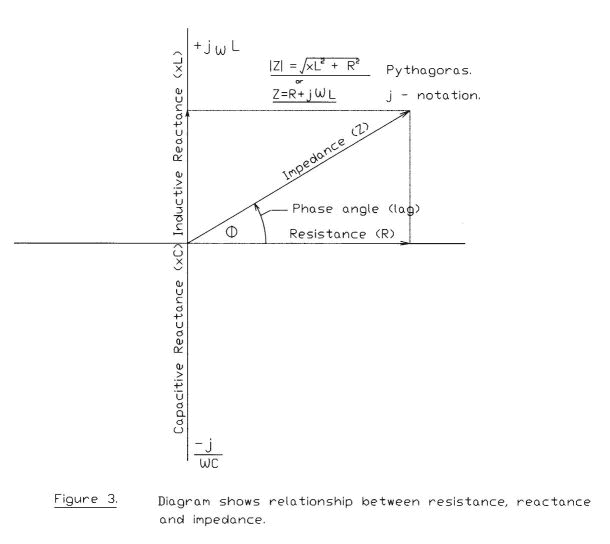 onsiderably
less than the applied voltage and the phase-angle of the resultant current
is consequently lagging due of the energy required to accelerate the cone
and the surrounding air-mass. The load's reactance as a result changes from
being inductive to capacitive, depending upon the degree of phase shift.
From our vector diagram (Figure 3) showing the
relationship of impedance with reactance and resistance we see that as the
phase-lag approaches 90 degrees, the load appears inductive (+j), becoming
resistive again at 180 degrees, then capacitive (-j) at 270 degrees until
finally, at 360 degrees or one whole cycle, resistive again. Examination
of a typical impedance v. frequency graph of a loudspeaker reveals how much
variation in phase-angle is experienced over the audio spectrum. Ideally,
we would aim for a non-reactive load where the impedance is constant, ie.
equal to the resistive or DC resistance value of the voice-coil (VC). This
would ensure a more constant current through the VC with frequency variation,
thereby ensuring a correspondingly proportional magnetic field to be generated.
Remember, it is the generated magnetic flux that performs the work of moving
the cone, and so in striving to maintain constant impedance, we ensure that
the loudspeaker responds more faithfully to the applied signal. As we increase
the resistance of the VC, ie. tend towards a constant-current drive, this
tends to minimise the effect of VC reactance upon the impedance. However,
it is obvious that more voltage-drive must be applied to the VC to provide
the same current. This of course, results in higher applied power, and this
is simply lost in the form of dissipated heat. Another approach would be
to phase-equalise the load at the output of the amplifier, and many amplifiers
incorporate a "Zobel" or step-network connected across the output.
This is very limited in its effect, as it only compensates for the general
trend of rising loudspeaker impedance with frequency. To be really effective,
such a network should provide a conjugate load to correct for every reactive
or impedance variation in the impedance graph. This is clearly not possible,
and even if it were, its characteristic would need to be changed for loudspeaker
loading changes! Therefore, this power-wasting resistance is perhaps the
only practical approach to minimising impedance variation. Let us now look
at how the amplifier's source impedance is related to the load impedance
in proportion to the damping factor. For example, with a DF of 10, the source
impedance would be 0.8 ohm. Apart from the risk of overdamping the loudspeaker,
it is obvious that an increase of damping factor will not be significant
when considering the comparatively large dc resistance of the voice-coil.
What is the point of this criticism of over-damping? Well, in order to achieve
this damping factor, usually large amounts of NFB are employed, and it is
the effect on transient response and phase detail that is of concern.
onsiderably
less than the applied voltage and the phase-angle of the resultant current
is consequently lagging due of the energy required to accelerate the cone
and the surrounding air-mass. The load's reactance as a result changes from
being inductive to capacitive, depending upon the degree of phase shift.
From our vector diagram (Figure 3) showing the
relationship of impedance with reactance and resistance we see that as the
phase-lag approaches 90 degrees, the load appears inductive (+j), becoming
resistive again at 180 degrees, then capacitive (-j) at 270 degrees until
finally, at 360 degrees or one whole cycle, resistive again. Examination
of a typical impedance v. frequency graph of a loudspeaker reveals how much
variation in phase-angle is experienced over the audio spectrum. Ideally,
we would aim for a non-reactive load where the impedance is constant, ie.
equal to the resistive or DC resistance value of the voice-coil (VC). This
would ensure a more constant current through the VC with frequency variation,
thereby ensuring a correspondingly proportional magnetic field to be generated.
Remember, it is the generated magnetic flux that performs the work of moving
the cone, and so in striving to maintain constant impedance, we ensure that
the loudspeaker responds more faithfully to the applied signal. As we increase
the resistance of the VC, ie. tend towards a constant-current drive, this
tends to minimise the effect of VC reactance upon the impedance. However,
it is obvious that more voltage-drive must be applied to the VC to provide
the same current. This of course, results in higher applied power, and this
is simply lost in the form of dissipated heat. Another approach would be
to phase-equalise the load at the output of the amplifier, and many amplifiers
incorporate a "Zobel" or step-network connected across the output.
This is very limited in its effect, as it only compensates for the general
trend of rising loudspeaker impedance with frequency. To be really effective,
such a network should provide a conjugate load to correct for every reactive
or impedance variation in the impedance graph. This is clearly not possible,
and even if it were, its characteristic would need to be changed for loudspeaker
loading changes! Therefore, this power-wasting resistance is perhaps the
only practical approach to minimising impedance variation. Let us now look
at how the amplifier's source impedance is related to the load impedance
in proportion to the damping factor. For example, with a DF of 10, the source
impedance would be 0.8 ohm. Apart from the risk of overdamping the loudspeaker,
it is obvious that an increase of damping factor will not be significant
when considering the comparatively large dc resistance of the voice-coil.
What is the point of this criticism of over-damping? Well, in order to achieve
this damping factor, usually large amounts of NFB are employed, and it is
the effect on transient response and phase detail that is of concern.
Let us now consider the sequence of events that occur during the passage
of signal as it travels around the global feedback loop. The signal passes
through to the loudspeaker, which, as we have discussed, produces a voltage
of its own. (back-EMF.) This voltage is fed back to the input of the amplifier
in such a sense as to subtract (hence the term "negative" feedback)
from it. This in turn causes a reduction of the output fed to the loudspeaker,
therefore, in the case of say a cone resonance which would result in a larger
voltage generated by the freer moving cone to be subtracted from the input,
thus reducing the drive from the output and compensate (hopefully) by damping
out the excess movement. This works very well as we are aware, especially
when demonstrated using a sine-wave signal of a relatively low-frequency
but what happens to fast rise-time transients? Many designers believe it
is sufficient to simply compensate by using a phase-lead capacitor. I deplore
the term, phase-lead in this context, the implication being that somehow
a future signal can be anticipated. As any video engineer can tell you,
this is only possible when the past history of the signal is known such
as when using a repetitive signal source, eg. a square-wave.
Consider such a square-wave signal fed through a NFB amplifier without
such compensation into a resistive load and observed on a cathode-ray oscilloscope
(CRO). The above amplifier has some inevitable phase-shift at the point
of response roll-off. Using our harmonic analysis theory, the higher odd-order
phase-shifted harmonics are causing time-shifted additions and subtractions
resulting in the effect we know as ringing. By the addition of our phase-lead
capacitor across the series NFB network, we are actually further lagging
the high odd-orders so that the "next available cycle" can restore
the signal to an approximation of a square-wave. Can you imagine what this
does to a sudden single transition as found in a typical musical waveform?
Of course the effects are very subtle and we recognise the instrument by
its pattern of sound, such is the wonder of our auditory sensory mechanism,
but vital phase information required to pinpoint positional information
has been seriously degraded in the process. Naturally, the system as a whole
has degraded this quality anyway, such are the imperfections of even the
finest reproducers, but the additional degradation due to NFB is very significant.
Further to my comments regarding the human ear, I would emphasise that the
ear is very sensitive to fast rate of change sound pressure levels or transients,
rather than the slower rise-times as we would find with pure tone or sine-wave.
Have you ever considered the SPL of the sound of a pin dropping (fast rate
of change) which is clearly audible in a quiet room?
In a particularly good article from "Audio" magazine (December
1962 p34) written by George Fletcher-Cooper a regular contributor at the
time simply titled "Series Feedback", he makes the following observations.
A transient arriving at the loudspeaker causes a resultant voltage to be
generated by the loudspeaker which after being fed back and subtracted from
the input arrives (after the delay caused by passing through the amplifier
again) at the loudspeaker, where the process is repeated indefinitely. This
according to Mr. Cooper has the potential of doing sufficient harm to the
transient wavefront shape to be of concern. He shows this diagrammatically
and mathematically in the article.
The conclusion from this is simply testing an amplifier for THD at various
frequencies (sine-wave) would not disclose this form of transient distortion.
Clearly many high-powered solid-state (and expensive) monitor and reference
amplifiers using NFB do not fall into this criticism. I believe that the
explanation lies in the huge current-sourcing capabilities of these large
amplifiers, many capable of hundreds of watts typically used in professional
applications. Having such high current capability ensures a very low output
impedance (inherent) therefore not relying on NFB to perform this task,
thus significantly reducing the loudspeaker's back-EMF voltage contribution
to the voltage fed back. Note that NFB only reduces output impedance for
in-phase signal components at the summing node for source and load. Generally
speaking, this is open-loop source impedance versus DC resistance of the
loudspeaker. This allows the NFB to linearise the characteristics of the
amplifier proper, a job it performs very well, while the loudspeaker damping
is provided by the inherently low source impedance. The reason given for
the use of high-powered amplifiers only to provide sufficient peak overload
margin may be a fallacious one or at least not the whole story.
The subject of NFB and the problems involved with achieving unconditional
stability and satisfying Nyquist's criteria for stability would fill a volume
alone, and still we have the dilemma of the effect of the reactive or complex
load when connected, so lets look at the possibility of using an amplifier
that uses zero NFB, thereby side-stepping all these problems.
Unfortunately, this limits our options, as a triode valve operated under
class-A conditions would appear to be the most linear and simple amplifier
we have available to us. Thus we must accept the disadvantages associated
with such an approach, such as high-voltage, heat, inefficiency and the
need to use an output transformer to name but a few.
Perhaps is now a pertinent time to look again at our SE, zero-NFB triode
amplifier and review various types of harmonic distortion and their respective
audibilities. The graphs included show computer simulated waveforms of fundamental
plus second harmonic only and fundamental and third harmonic only. A relatively
high percentage of 20% was used in order to emphasise the differences. Recalling
that as we approached the onset of overload, and thus the limit of usefulness
of the amplifier, our distortion looks similar to the graph showing second
harmonic. With the use of push-pull, the cancellation of even order harmonics
allows us to push the usefulness to the point of odd-order harmonic distortion,
and with the addition of NFB, the onset of clipping becomes more aggressive.
On the surface we can conclude well, so what? At a given power the performance
is still just as good and we have heavily reduced distortion allowing considerably
more power reserve. Well, unfortunately, in the interests of producing more
efficient and cost-effective amplifiers in conjunction with losing much
of this power by the use of less efficient loudspeakers, we restored the
status-quo with the result that for the same acoustic output, peaks and
short duration overloads are exhibiting very different harmonic distortion
characteristics. It is a well-known fact that the harmonic content of a
musical instrument increases as it is played louder. This is in the case
of say, a stringed instrument due to the limits of vibration excursion of
the string being approached, and clearly the resultant compression of the
waveform resembles that of second harmonic distortion, the same as in our
SE class-A triode amplifier. Perhaps this is why these amplifiers sound
apparently louder, as the resultant distortion is more familiar to us.
The explanation for the presence of second order harmonic that resembles
"squashing" of one half-cycle of the signal is as follows. During
the half-cycle of signal causing the single output valve's (or transistor)
current to increase, the resultant plate (or collector) impedance is
lower than the opposite half-cycle when the device is approaching device
cut-off point. This results in a lower output voltage in the load and the
degree of compression increases with reduction of load impedance. A glance
at the transfer characteristic of the output device will confirm this point.
With the push-pull amplifier came the solution and the trick was to have
matched output devices such that as one was approaching cut-off, the other
was beginning to conduct and in the ideal case, (matched output devices)
both would work to approach a more constant output impedance. This effect
could be employed according to the whims of the design engineer and became
known as the class of operation. These are commonly class-A, AB1, AB2 and
B. Accordingly NFB was used to reduce forms of cross-over distortion as
a result of less-than-ideal device matching. It is the author's opinion
that this form of distortion is the most objectionable by far, so much care
needs to be taken by the designer employing class-B. The types of THD present
in push-pull amplifiers have already been covered.
Well at this point having had the audacity to question so many accepted
norms, possibly people may well wish to point out flaws in my discussion
(I prefer not to think in terms of an argument, as this article is simply
conjecture on my part) and their comments, suggestions, corrections etc.
would be most welcome as it is the acquisition of knowledge in these fascinating
fields that is of prime importance to me. It seems the more I research and
learn only serves to highlight my ignorance of this topic.
If I have failed to convince by objective reasoning, then that is due
to my inadequacy, but one thing that I state emphatically and having enthusiastic
approval from all who have heard my prototypes, SE triode, zero-NFB amplifiers
are much more pleasing to listen to and any person wishing to purchase a
Quad 405 amplifier can contact me and I will be pleased to negotiate a deal!
In conclusion, it is perhaps not hard to see why amplifier designs have
(in my humble opinion) erred slightly from the ideal path. Firstly, more
"efficient" pentodes were utilised to allow radio manufacturers
to use at least one less valve, then class-AB afforded higher efficiencies,
followed by many designs intended to restore pentode performance to more
closely approach, but never quite reach, triode performance. Several very
successful examples include the development of the beam-power or "kink-less"
tetrode and partial triode operation, otherwise known as "ultra-linear".
These were cost motivated in a very competitive radio and later hi-fidelity
market. With the advent of solid-state and complementary NPN-PNP devices
it enabled the elimination of the costly and unwieldy output transformer
and without the phase-rotation effects around the band-edges of the frequency
response, highly efficient class-B could be employed using huge amounts
of negative feedback to bring the THD (in some instances tested at 1kHz
only!) down to levels we were comfortable with for valve amplifiers. In
order to satisfy the requirements for unconditional stability, considerable
HF roll-off within the feedback loop had to be introduced. With many of
the early solid-state amplifiers any attempt to produce the stated power
output at frequencies much higher than 10 kHz resulted in the sine-wave
input becoming a triangle waveform at the output. They had produced an integrator
for high frequencies! With the limited energy content of HF information
on the vinyl recordings of the day, it was not as apparent, but astute listeners
soon denounced these products. You may recall the "birth" of transient
intermodulation (TIM) or slew-induced distortion measurements, introduced
by manufacturers of solid-state amplifiers that relied upon less NFB or
nested loop, rather than global NFB, eager to demonstrate their amplifiers
did not fall into the above category.
It would appear that some form of solid-state amplifying device that
is more linear without the high dependence of NFB would be the answer, but
until that time those people to whom the highest quality of reproduction
of music is paramount, will gladly accept the extra difficulties associated
with valve amplifiers.
The power MOSFET appears to be a likely candidate, but has some problems.
There are volumes that could be written not only about power MOSFETS, but
about all of the components in a high-quality reproducing amplifier, especially
the wrongfully and much maligned audio output transformer. Perhaps discussion
on such topics including the use of load-lines and transfer characteristics
in the design of more linear amplifiers and these components could form
the basis for a future article? Also new improved valves are now available
from the Russian valve manufacturers who have been busy working to improving
the humble thermionic valve long after the western world had abandoned them
in favour of the transistor. Some of the new specifications coming from
these companies are astoundingly linear and very worthy of further consideration.
I would like to acknowledge the invaluable contributions made by the many
very knowledgable people in the various articles and papers I have read,
and include a list of authors and journals that I would strongly recommend
reading. These may be a little difficult because of their age to locate,
and although I have these in my possession, I am not sure about the possibility
of copyright violation if I was to distribute copies. I hope in some way
this discussion has at least encouraged others to question established practice,
as for me I feel a great sense of relief in having at least consolidated
many of my thoughts on paper. Most important of all- trust your ears above
all else.
Waren Lane's permission
to published this paper
is gratefully acknowledged. August 1999.